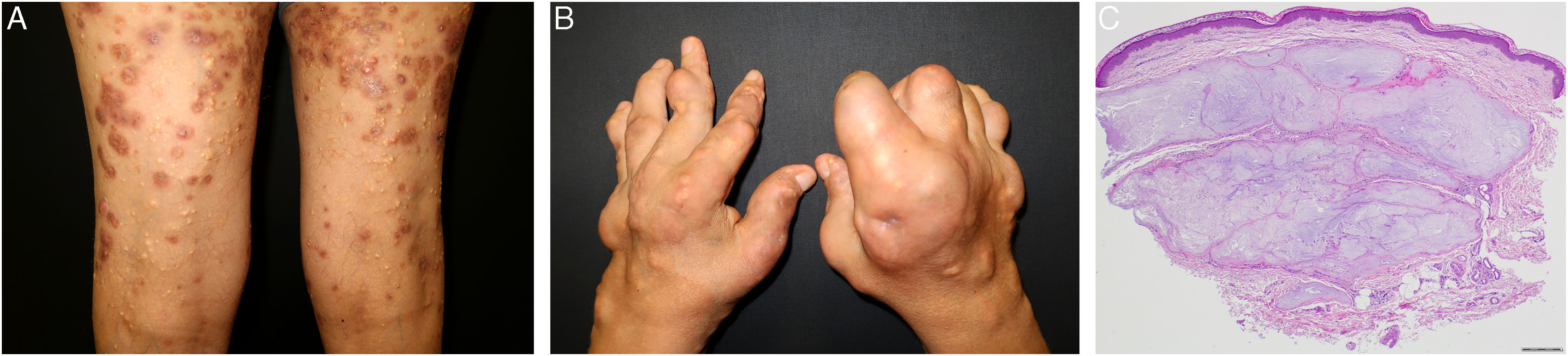
A 38-year-old man from Guatemala, with a past medical history of HIV infection and chronic kidney disease due to Bartter syndrome type III, presented with a 1-year history of generalized cutaneous lesions, predominantly on the trunk and extremities. The lesions consisted of millimetric whitish-yellow papules of firm consistency, resembling milia cysts (Fig. 1A) He reported that some of the lesions progressed toward ulceration, with drainage of whitish material followed by healing with residual hyperpigmentation. Furthermore, he described larger periarticular nodules on the hands, painful and associated with significant digital deformity (Fig. 1B). He had not experienced fever or other associated symptoms.
Histopathologic and laboratory findings
Histologic examination of one of the nodules revealed the presence of dermal aggregates of pink amorphous material surrounded by a mild lymphohistiocytic inflammatory infiltrate (Fig. 1C). Lab test results showed uric acid levels of 9.58mg/dL (normal up to 6.8mg/dL). There were no abnormalities in calcium-phosphate metabolism or in the lipid profile.
What is your diagnosis?
DiagnosisMiliar gout.
DiscussionGout is a common disease caused by the deposition of monosodium urate (MSU) crystals in synovial fluid and other tissues.1 Cutaneously, tophi are the classic presentation and manifest as firm subcutaneous nodules.1 Miliar gout, or disseminated cutaneous gout, is a rare clinical variant of tophaceous gout characterized by millimetric papules filled with tophaceous material that resemble milia cysts.1 Unlike classic tophi, which typically form periarticularly and in acral regions, miliar gout appears in areas distant from joints, most frequently on the extremities, particularly the thighs.4,5
It is more common in middle-aged men, usually in the context of hyperuricemia.2,3 However, as it happens with gouty arthritis, normal serum uric acid levels do not exclude the diagnosis of miliar gout.3 Moreover, miliar gout may be the first cutaneous sign of the disease; in fact, most cases reported in the literature developed in patients without a prior history of gout.2–4 Differential diagnosis should include entities such as calcinosis cutis, cutaneous oxalosis, eruptive milia cysts, eruptive xanthomas, and perforating dermatoses.
Histologically, conventional formalin fixation and hematoxylin-eosin staining dissolve MSU crystals, leaving behind amorphous pink/grayish material in the dermis or subcutis, which may be surrounded by palisading granulomas or foreign-body granulomas.2–4 Confirmation would require alcoholic fixation, which preserves the crystals, allowing visualization of negatively birefringent structures under polarized light; however, currently, this is rarely performed due to technical complexity.5
Our patient had Bartter syndrome type III, a tubulopathy caused by mutations in the CLCNKB gene (chromosome 1p36), which encodes a chloride channel in the loop of Henle.6 This genetic alteration mimics the effects of chronic furosemide use, predisposing to renal insufficiency and hyperuricemia.6 Both renal insufficiency and chronic diuretic use have been associated with miliar gout, as have hypertension, obesity, diabetes mellitus, and alcohol consumption.2–4
Miliar gout may partially or even completely resolve with urate-lowering therapy.2 In the present case, treatment with febuxostat was initiated, resulting only in temporary normalization of uric acid levels due to poor adherence, without clinical improvement at the 4-month follow-up.