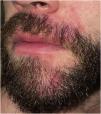

The index case was a 30-year-old cisgender homosexual man who was using HIV pre-exposure prophylaxis (PrEP) and had a past medical history of multiple sexually transmitted infections (STIs) in the previous year. He presented with a 3-month history of several erythematous plaques with well-defined borders and some perifollicular papulopustules located on the chin, left nasolabial fold, and upper lip. The patient reported partial improvement after treatment with topical corticosteroids (Fig. 1).

He denied contact with animals or the presence of lesions elsewhere. However, he mentioned that one of his sexual partners had similar lesions and was also evaluated. This second patient was another cisgender homosexual man, also a PrEP user with a past medical history of multiple STIs during the previous year, who presented with a plaque with a scaly border and central pustules on the upper lip (Fig. 2).

The two patients reported having attended a sauna, where they had engaged in sexual intercourse with other men a few days prior to symptom onset.
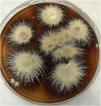
Samples were collected for various STI tests, and fungal cultures were performed from lesion scrapings using Sabouraud CMP medium with cycloheximide (Becton Dickinson). After 10 days of incubation at 30°C under aerobic conditions, whitish, cottony, velvety, and powdery colonies were obtained (Fig. 3).

What is your diagnosis?
DiagnosisTinea barbae due to Trichophyton mentagrophytes genotype VII (TMVII) transmitted through sexual contact.
Diagnosis and treatmentThe fungal culture from lesion scrapings showed colonies which were consistent with Trichophyton spp. Species identification by mass spectrometry (MALDI-TOF MS, Bruker Diagnostics) tested positive for T. mentagrophytes (score>2). For genotypic differentiation, the ITS regions were sequenced at an external laboratory following the protocol described by Jabet et al.2 In both cases, T. mentagrophytes genotype VII (TMVII) was identified.
Based on these findings, a 28-day regimen of oral terbinafine 250mg/day and topical terbinafine every 12h was prescribed, resulting in complete clinical resolution.
DiscussionDermatophytoses are fungal infections due to 3 genera of fungi: Microsporum, Trichophyton, and Epidermophyton, known for their ability to invade keratinized tissues such as hair, skin, and nails. Transmission occurs through direct contact with infected hosts or via fomites.1
Over the past decade, several reports have raised the hypothesis of sexual transmission of these dermatophytes1–6 as an example of direct person-to-person transmission, similar to that previously described in combat sports (tinea gladiatorum).1
In 2019, a specific genotype of T. mentagrophytes (genotype VII) was identified in a few patients with tinea genitalis, in whom sexual transmission was suspected based on the lesion location, temporal relationship between sexual contact and onset of lesions, and the appearance of infection in sexual partners.4–6
Recently, Jabet et al.2 described 13 cases of TMVII infection in men who have sex with men (MSM), which were considered highly suggestive of sexual transmission.
The cases described in this report represent the first cases of tinea barbae in Spain caused by TMVII infection, with strong suspicion of transmission in a sexual context, given the location of the lesions and their sequential appearance in sexual partners.
Regarding the origin of infection, it is believed that there is active international circulation of TMVII, as more than 60 cases have been reported in Europe since 2014, with Southeast Asia possibly being the origin of spread, as suggested by the first cases reported after travel to that region.4,5
Of note, although transmission predominantly occurs in the context of sexual activity, we do not believe it should be categorized as a STI, as proposed by some authors, but rather as an infection transmissible through close physical contact, which may occur in the context of sexual intercourse.
More cases are likely to emerge in the coming future; therefore, a high level of clinical suspicion, appropriate sampling and microbiologic analysis for pathogen identification, early treatment, and contact tracing are essential to prevent further spread.
The treatment of choice for TMVII infection is a 4-week regimen of oral terbinafine 250mg/day or until clinical resolution. Itraconazole or griseofulvin may be used as alternatives.
In conclusion, when TMVII-induced dermatophytosis is identified, sexual transmission should be considered, and if confirmed, screening for sexually transmitted infections should be performed in the patient and their sexual partners.1
Conflict of interestThe authors declare that they have no conflict of interest.