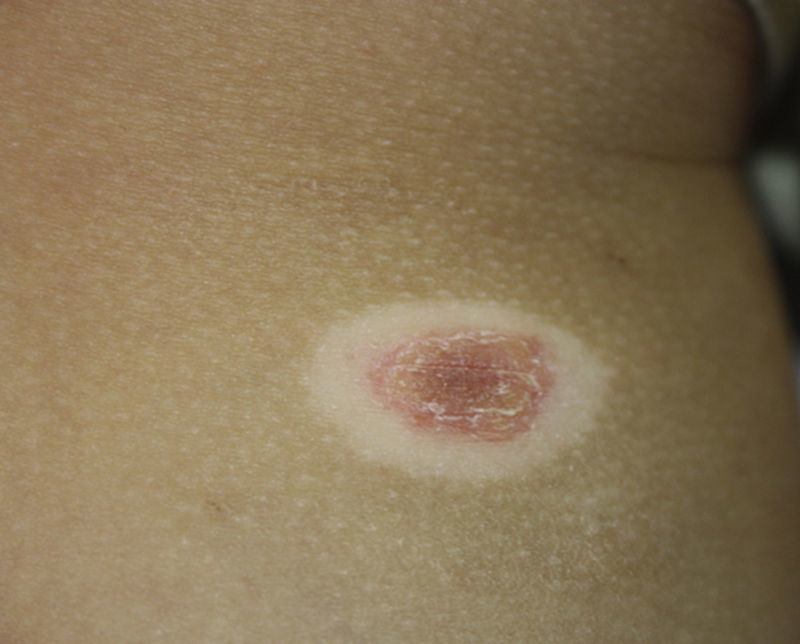
A 7-year-old girl with no past history of interest presented an asymptomatic pigmented congenital lesion on the posterior aspect of the left thigh. Four months earlier the lesion had become pruritic, with central redness and flaking, and peripheral clearing.
Dermatologic examination revealed a brownish oval lesion measuring 1cm in diameter, with a desquamating erythematous surface and a peripheral hypopigmented halo of 4mm (Fig. 1).
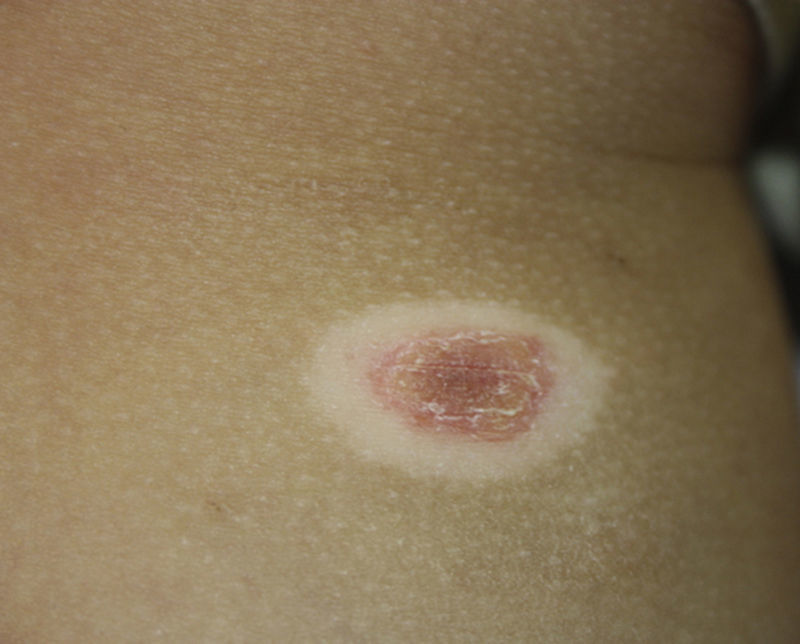
The Meyerson phenomenon refers to an eczematous reaction arising on a previous, typically melanocytic skin lesion. It is a benign and usually asymptomatic phenomenon that is uncommon in children. The halo or Sutton nevus is a benign, typically acquired melanocytic nevus with a peripheral achromic halo; it is common in children.
Coexistence of the Meyerson phenomenon and halo nevus in distinct lesions in a single patient has been reported, as the progression of a Meyerson nevus to a halo nevus, and vice versa. However, there are no previous reports of the simultaneous presence of both phenomena in a single nevus. We have presented an example of a melanocytic lesion in which the Sutton and Meyerson phenomena (SU-ME phenomenon) coexisted.
Please cite this article as: Vázquez-Osorio I. Coexistencia de 2 fenómenos: Sutton y Meyerson. Actas Dermosifiliogr. 2017;108:671.