


To characterize temporal trends in mortality from melanoma and non-melanoma skin cancer in Colombia between 2008 and 2022.
MethodsA temporal trend study of melanoma and non-melanoma skin cancer mortality in Colombia from 2008 to 2022 was conducted using death records reported by the Departamento Administrativo Nacional de Estadística (DANE). Mortality rates were estimated according to sex, age, and area of residence.
ResultsA total of 11,891 deaths were identified, including 4874 due to melanoma and 7017 due to non-melanoma skin cancer. Among deaths from melanoma and non-melanoma skin cancer, 52.6% and 54.1%, respectively, occurred in men, compared with 47.4% and 45.9%, respectively, in women. Mortality from non-melanoma skin cancer showed an increasing trend from 2020 onward, rising by 18.5% in women and 15.8% in men. In contrast, melanoma mortality remained stable in recent years.
ConclusionMortality from non-melanoma skin cancer in Colombia shows an increasing trend, whereas melanoma mortality has stabilized. Mortality is more frequent among men, individuals older than 65 years, and residents of urban areas. This pattern contrasts with the decline observed in high-income countries, where prevention, early diagnosis, and treatment have been fundamental to improving prognosis.
Skin cancer includes melanoma and non-melanoma skin cancer, the latter primarily referring to basal cell carcinoma (BCC) and squamous cell carcinoma (SCC). Its epidemiology has changed substantially over recent decades, and its incidence worldwide has been increasing.1,2
This increase is largely attributable to lifestyle changes that have increased exposure to known risk factors, such as prolonged sun exposure, tanning practices, and more frequent exposure to ultraviolet (UV) radiation.1,2 However, it has also been attributed to other factors, including population aging, early detection, and the use of advanced diagnostic techniques in countries with a high Human Development Index (HDI). Furthermore, these countries have been found to have a higher prevalence of other risk factors for developing skin cancer, including smoking, alcohol consumption, unhealthy dietary patterns, and chronic conditions such as obesity and hypertension.3,4 The incidence has increased to such an extent that skin cancer has been described as a growing epidemic.5
The most recent data from the World Health Organization (WHO) suggest that, in 2022, a total of 69,416 people worldwide died from non-melanoma skin cancer and 58,667 died from melanoma. A total of 10% of all melanoma-related deaths and 11.7% of non-melanoma-skin cancer occurred in Latin America and the Caribbean.6
Although skin cancer is considered less frequent in low- and middle-income regions such as Africa, Latin America, and Asia, its impact may be substantial because of the high mortality documented in these areas.7,8 This may be explained by the fact that the level of development of health care services has a substantial impact on survival among patients diagnosed with cancer.9 Delays in diagnosis and treatment, difficulties in accessing health care, and difficulties in receiving appropriate follow-up have been associated with lower survival rates in these patients.9
In Colombia, a middle-income country, 6695 new cases of melanoma and 8318 new cases of non-melanoma skin cancer were reported in 2022. However, timely diagnosis in these patients was suboptimal.10 The median waiting time from diagnosis to treatment was 65 days (IQR, 44–104) among patients with melanoma and 80 days (IQR, 48–125) among patients with non-melanoma skin cancer.11
Given the above, and considering the scarcity of data in the literature regarding the impact of skin cancer in low- and middle-income countries, the present study aimed to identify temporal trends in mortality from melanoma and non-melanoma skin cancer in Colombia, a middle-income country, between 2008 and 2022.
MethodsWe conducted an ecological temporal trend study of mortality from melanoma and non-melanoma skin cancer in Colombia from 2008 through 2022. All deaths from these causes were identified in the national death records reported by the Departamento Administrativo Nacional de Estadística (DANE).10
To identify deaths due to melanoma, all records in which the underlying cause of death included one of the ICD-10 codes C43.0–C43.9 (malignant melanoma of the skin) were collected. For deaths related to non-melanoma skin cancer, ICD-10 codes C44.0–C44.9 (other malignant neoplasms of the skin) were used.12
All death records for men and women with complete information on sex, age, and area of residence were included. Individuals were categorized into four age groups: younger than 30 years, 30–44 years, 45–64 years, and older than 65 years. Area of residence was classified as urban (municipal seat) or rural (populated center and dispersed rural area).
Sex-, age-, and area-of-residence-specific mortality rates were estimated using population estimates from DANE based on the 2018 National Population and Housing Census (CNPV).13 All analyses were performed using R version 4.4.1.
Mortality trends for melanoma and non-melanoma skin cancer were identified according to sex, age, and area of residence. For this purpose, the annual percentage change (APC) was estimated. When the APC was statistically significant (P<.05), the trend was interpreted as increasing when the APC was >0 and decreasing when it was <0. When the APC was not statistically significant, the trend was considered stable when the value ranged from −0.5 to 0.5 and was considered a nonsignificant change when it fell outside this range (e.g., <−0.5 or >0.5).14
In addition, a joinpoint Poisson regression analysis was performed to identify points at which the trend changed significantly. The Joinpoint Regression Program, version 5.2.0, was used for this analysis.14
This study was classified as research without risk in accordance with Colombian legislation (Resolution 8430 of 1993 of the Ministry of Health of the Republic of Colombia), because it was based on records and individual identification was not possible.
ResultsA total of 11,891 deaths were identified during the study period: 4874 due to melanoma and 7017 due to non-melanoma skin cancer.
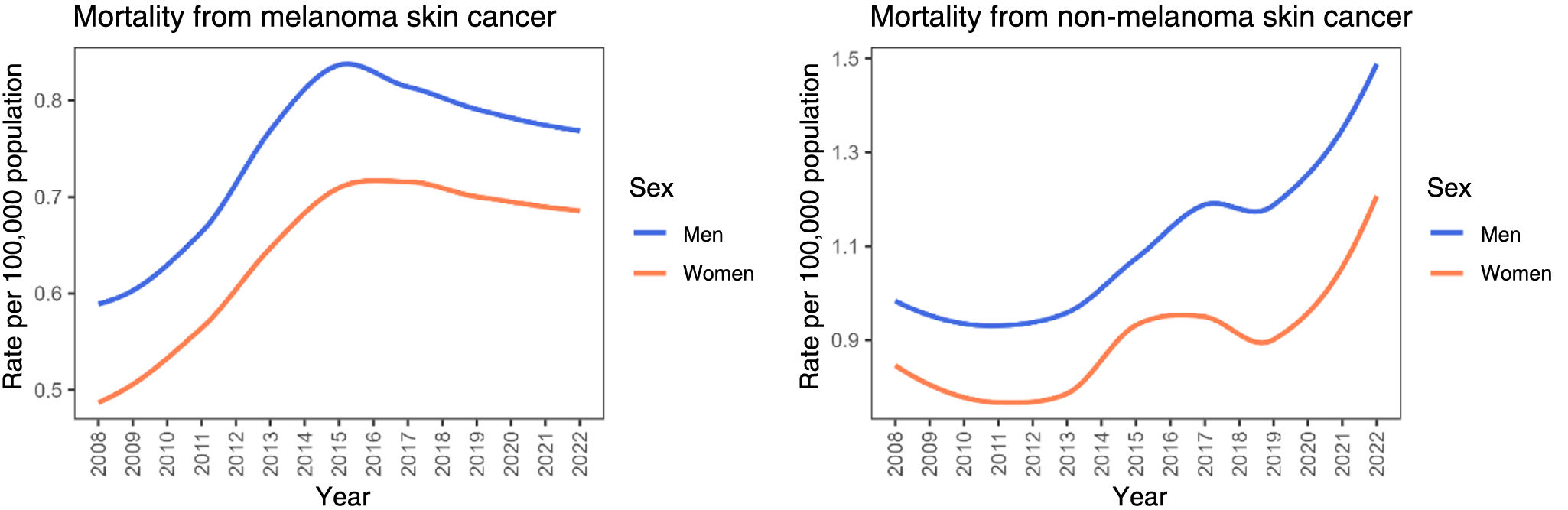
By sex, 52.6% (n=2563) and 54.1% (n=3799) of deaths from melanoma and non-melanoma skin cancer, respectively, occurred in men, whereas 47.4% (n=2311) and 45.9% (n=3218), respectively, occurred in women. Details of sex-specific mortality rates for each year are shown in Fig. 1.

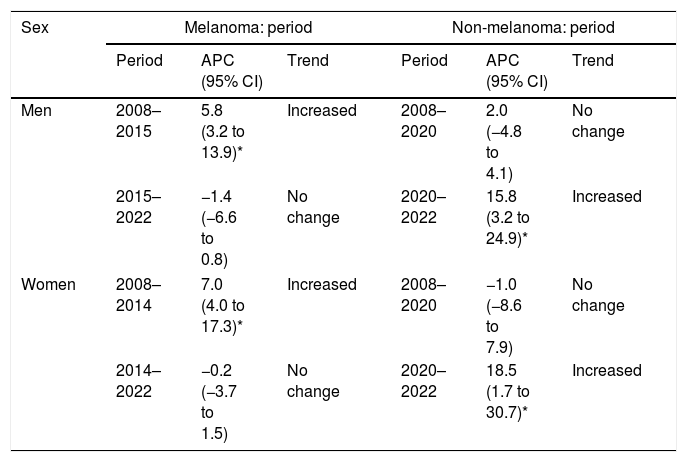
The trend in mortality from non-melanoma skin cancer remained unchanged in both sexes until 2020. Subsequently, it increased, with APC values of 18.5 and 15.8 in women and men, respectively, between 2020 and 2022. In contrast, the trend in melanoma mortality increased significantly until 2015 in men and 2014 in women and subsequently remained stable (Table 1).
Trends in mortality from melanoma and non-melanoma skin cancer by sex in Colombia, 2008–2022.
| Sex | Melanoma: period | Non-melanoma: period | ||||
|---|---|---|---|---|---|---|
| Period | APC (95% CI) | Trend | Period | APC (95% CI) | Trend | |
| Men | 2008–2015 | 5.8 (3.2 to 13.9)* | Increased | 2008–2020 | 2.0 (−4.8 to 4.1) | No change |
| 2015–2022 | −1.4 (−6.6 to 0.8) | No change | 2020–2022 | 15.8 (3.2 to 24.9)* | Increased | |
| Women | 2008–2014 | 7.0 (4.0 to 17.3)* | Increased | 2008–2020 | −1.0 (−8.6 to 7.9) | No change |
| 2014–2022 | −0.2 (−3.7 to 1.5) | No change | 2020–2022 | 18.5 (1.7 to 30.7)* | Increased | |
APC, annual percentage change; 95% CI, 95% confidence interval.
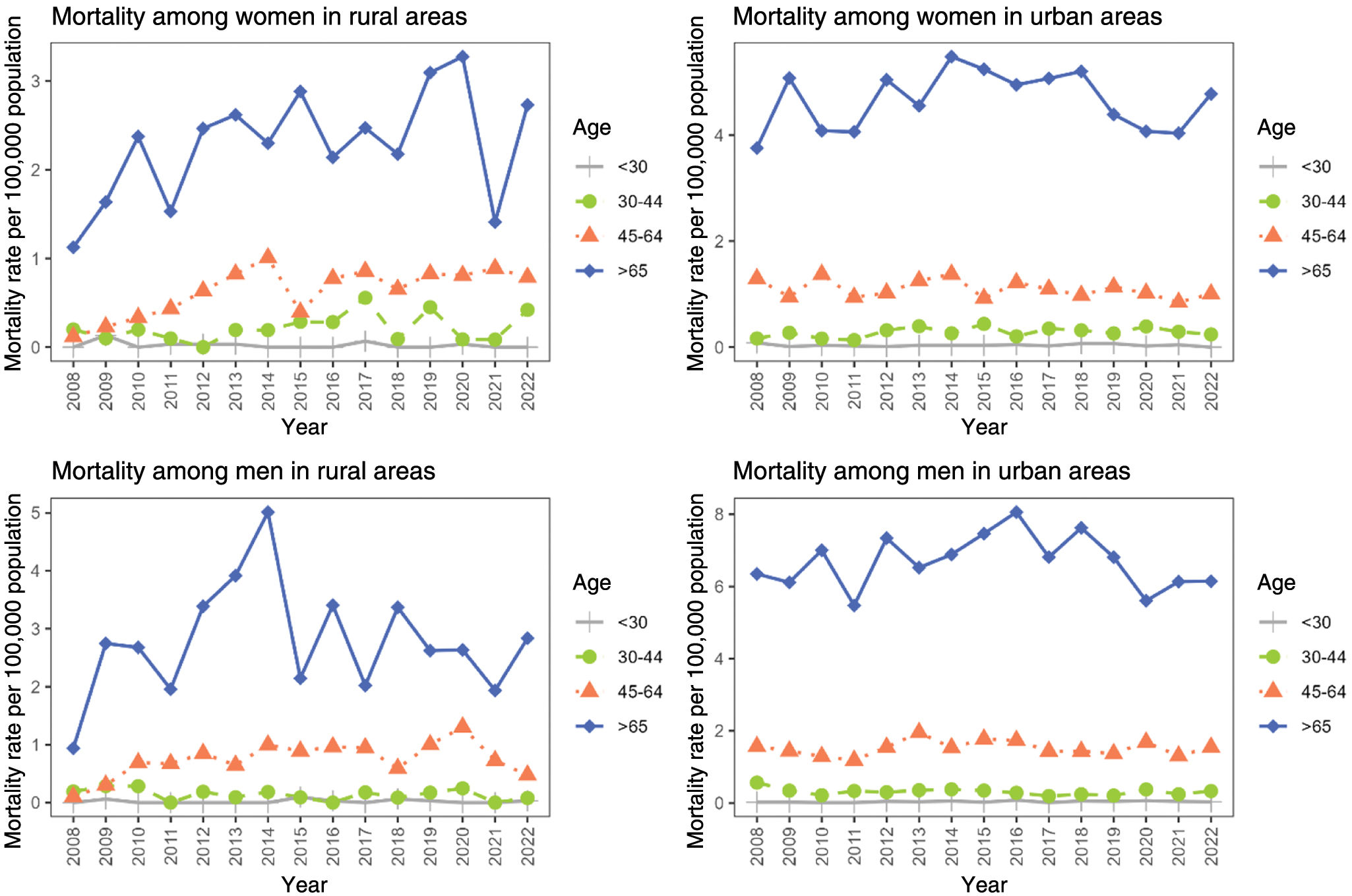
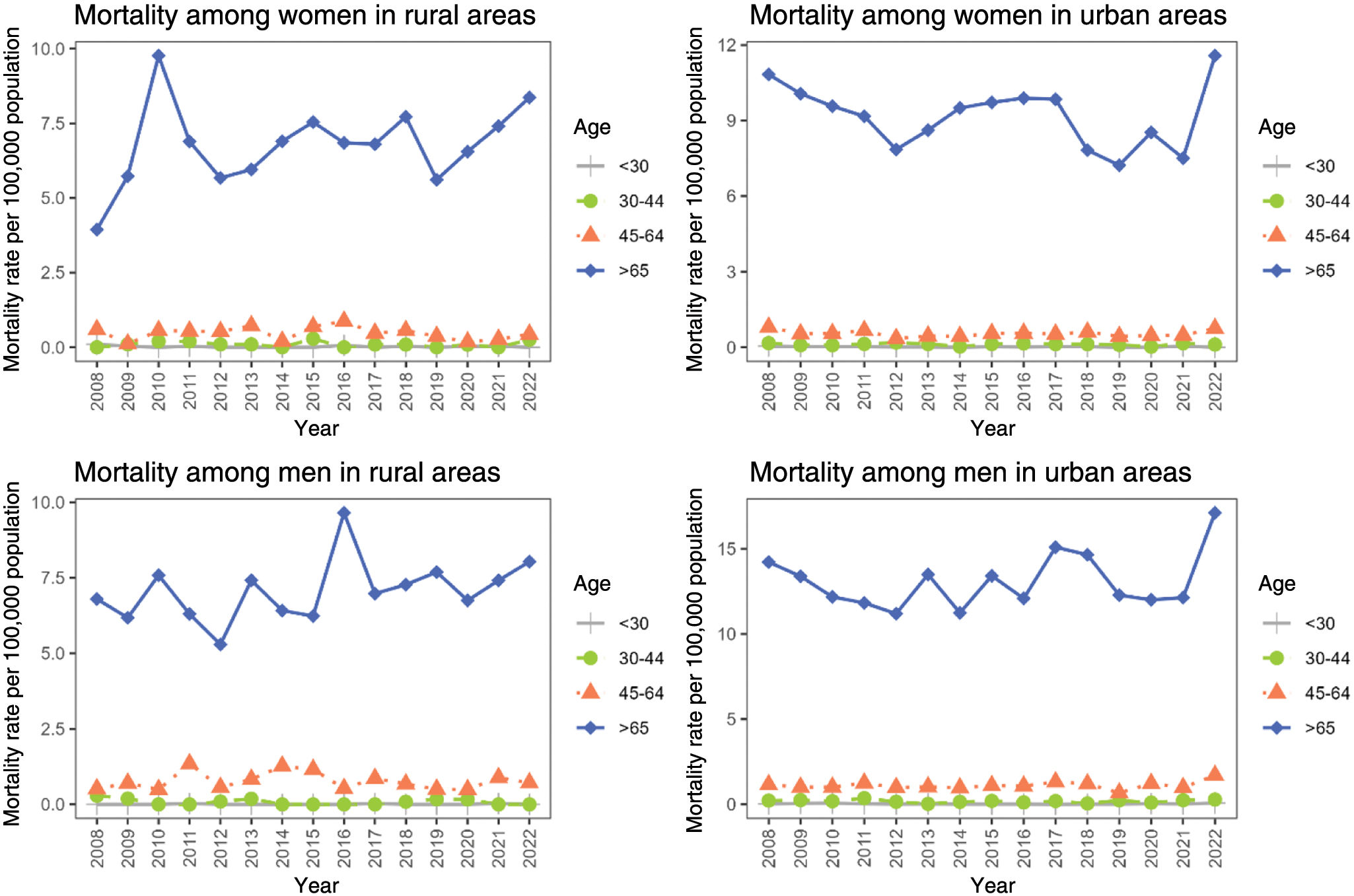
Mortality from both melanoma and non-melanoma skin cancer was more frequent among older individuals. For melanoma, 56.2% of deaths occurred among individuals older than 65 years, 33.3% among those aged 45–64 years, 8.1% among those aged 30–44 years, and 2.4% among those younger than 30 years (Fig. 2). Similarly, 80.1% of deaths from non-melanoma skin cancer occurred among individuals older than 65 years, 15.3% among those aged 45–64 years, 2.8% among those aged 30–44 years, and 1% among those younger than 30 years (Fig. 3).


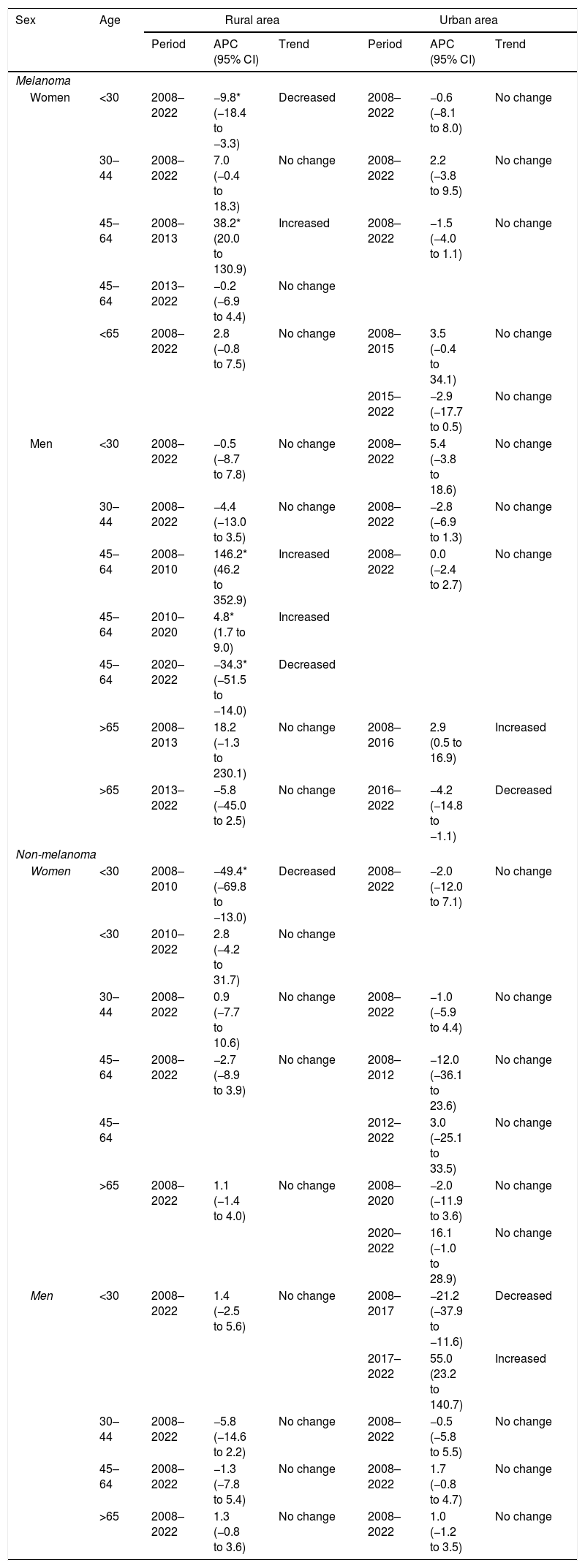
According to area of residence, mortality was higher in urban areas. Of the deaths from melanoma and non-melanoma skin cancer, 86% and 82%, respectively, occurred in urban areas (Figs. 2 and 3). Nevertheless, significant inflection points were identified showing that, in rural areas, the trend in melanoma mortality among individuals aged 45–64 years increased until 2013 in men and 2020 in women. After these years, the trend stabilized in women, whereas it decreased in men. Conversely, mortality from non-melanoma skin cancer among women younger than 30 years living in rural areas decreased until 2010 and showed no significant changes thereafter (Table 2).
Trends in mortality from melanoma and non-melanoma skin cancer by sex, age, and area of residence in Colombia, 2008–2022.
| Sex | Age | Rural area | Urban area | ||||
|---|---|---|---|---|---|---|---|
| Period | APC (95% CI) | Trend | Period | APC (95% CI) | Trend | ||
| Melanoma | |||||||
| Women | <30 | 2008–2022 | −9.8* (−18.4 to −3.3) | Decreased | 2008–2022 | −0.6 (−8.1 to 8.0) | No change |
| 30–44 | 2008–2022 | 7.0 (−0.4 to 18.3) | No change | 2008–2022 | 2.2 (−3.8 to 9.5) | No change | |
| 45–64 | 2008–2013 | 38.2* (20.0 to 130.9) | Increased | 2008–2022 | −1.5 (−4.0 to 1.1) | No change | |
| 45–64 | 2013–2022 | −0.2 (−6.9 to 4.4) | No change | ||||
| <65 | 2008–2022 | 2.8 (−0.8 to 7.5) | No change | 2008–2015 | 3.5 (−0.4 to 34.1) | No change | |
| 2015–2022 | −2.9 (−17.7 to 0.5) | No change | |||||
| Men | <30 | 2008–2022 | −0.5 (−8.7 to 7.8) | No change | 2008–2022 | 5.4 (−3.8 to 18.6) | No change |
| 30–44 | 2008–2022 | −4.4 (−13.0 to 3.5) | No change | 2008–2022 | −2.8 (−6.9 to 1.3) | No change | |
| 45–64 | 2008–2010 | 146.2* (46.2 to 352.9) | Increased | 2008–2022 | 0.0 (−2.4 to 2.7) | No change | |
| 45–64 | 2010–2020 | 4.8* (1.7 to 9.0) | Increased | ||||
| 45–64 | 2020–2022 | −34.3* (−51.5 to −14.0) | Decreased | ||||
| >65 | 2008–2013 | 18.2 (−1.3 to 230.1) | No change | 2008–2016 | 2.9 (0.5 to 16.9) | Increased | |
| >65 | 2013–2022 | −5.8 (−45.0 to 2.5) | No change | 2016–2022 | −4.2 (−14.8 to −1.1) | Decreased | |
| Non-melanoma | |||||||
| Women | <30 | 2008–2010 | −49.4* (−69.8 to −13.0) | Decreased | 2008–2022 | −2.0 (−12.0 to 7.1) | No change |
| <30 | 2010–2022 | 2.8 (−4.2 to 31.7) | No change | ||||
| 30–44 | 2008–2022 | 0.9 (−7.7 to 10.6) | No change | 2008–2022 | −1.0 (−5.9 to 4.4) | No change | |
| 45–64 | 2008–2022 | −2.7 (−8.9 to 3.9) | No change | 2008–2012 | −12.0 (−36.1 to 23.6) | No change | |
| 45–64 | 2012–2022 | 3.0 (−25.1 to 33.5) | No change | ||||
| >65 | 2008–2022 | 1.1 (−1.4 to 4.0) | No change | 2008–2020 | −2.0 (−11.9 to 3.6) | No change | |
| 2020–2022 | 16.1 (−1.0 to 28.9) | No change | |||||
| Men | <30 | 2008–2022 | 1.4 (−2.5 to 5.6) | No change | 2008–2017 | −21.2 (−37.9 to −11.6) | Decreased |
| 2017–2022 | 55.0 (23.2 to 140.7) | Increased | |||||
| 30–44 | 2008–2022 | −5.8 (−14.6 to 2.2) | No change | 2008–2022 | −0.5 (−5.8 to 5.5) | No change | |
| 45–64 | 2008–2022 | −1.3 (−7.8 to 5.4) | No change | 2008–2022 | 1.7 (−0.8 to 4.7) | No change | |
| >65 | 2008–2022 | 1.3 (−0.8 to 3.6) | No change | 2008–2022 | 1.0 (−1.2 to 3.5) | No change | |
APC, annual percentage change; 95% CI, 95% confidence interval.
In urban areas, the trend in melanoma mortality increased until 2016 among men older than 65 years and subsequently decreased. In contrast, the trend in mortality from non-melanoma skin cancer among men younger than 30 years decreased until 2017 but increased thereafter (Table 2).
DiscussionDifferences in mortality from melanoma and non-melanoma skin cancer were identified. Overall, mortality was higher among men, who accounted for 53% and 54% of deaths from melanoma and non-melanoma skin cancer, respectively. Furthermore, mortality was higher in urban areas, where 86% of deaths from melanoma and 82% of deaths from non-melanoma skin cancer occurred. In addition, mortality was more frequent among individuals older than 65 years; 80.1% of deaths from non-melanoma skin cancer and 56.2% of deaths from melanoma occurred in this age group.
Similarly, differences in mortality trends were identified. The inflection points showed that, from 2014 and 2015 onward, the trend in melanoma mortality changed from increasing to stable in women and men, respectively. In contrast, mortality from non-melanoma skin cancer increased significantly in both sexes from 2020 onward.
These findings are consistent with global trends showing a decrease or stabilization in melanoma mortality and an increase in mortality from non-melanoma skin cancer.15 According to data from the 2017 and 2019 Global Burden of Disease studies, skin cancer-related deaths were significantly more frequent among men and, overall, occurred at older ages in both sexes. Furthermore, the incidence and mortality trends for non-melanoma skin cancer were predicted to continue increasing in subsequent years.16,17 Similarly, in Brazil, Nader et al. found that melanoma mortality was higher among men older than 60 years. They also found that the trend remained stable among women and individuals younger than 60 years.18
Regarding differences according to area of residence, the results are similar to those reported by Hernández et al., who found that, in the United States between 2000 and 2017, the largest number of deaths among patients with melanoma occurred in urban areas. However, they observed that the risk of mortality was higher in rural areas because patients living in rural areas were less likely to undergo surgery and had shorter survival (HR, 1.19; 95% CI, 1.02–1.40).19 In the present study, mortality was also higher in urban areas; however, it was not possible to determine the risk of mortality in rural areas because this was beyond the scope of the study.
Of note, mortality rates from non-melanoma skin cancer reached 1.5 deaths per 100,000 population among men. When stratified by age and area of residence, rates of up to 15 deaths per 100,000 population were identified among men living in urban areas. These figures were higher than those reported by Sendín-Martín et al., who identified a sex-specific mortality rate of 1.16 deaths per 100,000 population among men in Spain.20 This may be explained by the fact that cancer survival is lower in low- and middle-income countries because of lower levels of healthcare-system development and reduced efficiency in providing early diagnosis, timely treatment, and appropriate clinical follow-up.21
Moreover, the higher mortality among men may be associated with occupational exposure to solar ultraviolet (UV) radiation. Between 2000 and 2019, deaths from skin cancer attributable to occupational exposure to sunlight increased by 88%.22 In 2019, an estimated 29% of all deaths from non-melanoma skin cancer were attributable to this occupational risk factor, with higher mortality in the African Region, the Region of the Americas, the Western Pacific Region, men, and middle-aged individuals.23
Another associated factor is the impact of inequalities in skin cancer prevention measures. A global survey found that the use of measures to protect against UV radiation was more frequent among women and individuals with higher educational attainment. Similarly, self-examination and consultation with a dermatologist were more likely among individuals with higher socioeconomic status and educational attainment.24
The inflection point identified in 2020, after which mortality from non-melanoma skin cancer increased in both sexes, is particularly noteworthy. Although the impact of the COVID-19 pandemic on skin cancer outcomes is not yet fully understood, studies conducted by different authors worldwide have shown that the pandemic significantly affected the diagnosis of this disease. The reduction and postponement of nonurgent medical consultations during this period resulted in fewer biopsies being performed, adversely affecting the early detection of skin cancer and access to specialized care.25–28
Finally, barriers to access to diagnosis and treatment in Colombia may contribute to differences in mortality. Factors associated with delayed diagnosis of skin cancer include a low density of dermatologists, insufficient expertise among other physicians, such as general practitioners, in diagnosing skin cancer, and prolonged waiting times for specialist care.29,30
Conversely, the inflection points in the melanoma mortality trend identified in 2014 and 2015 coincide with the approval of immunotherapy for this disease. Although stabilization of the trend cannot be directly attributed to the use of these therapies, several clinical trials demonstrated their beneficial effects on survival among patients with melanoma, leading the Food and Drug Administration (FDA) to approve nivolumab and pembrolizumab during those years.31,32 Similarly, in Colombia, the Instituto Nacional de Vigilancia de Medicamentos y Alimentos (INVIMA) authorized these treatments in 2016.33,34
The main limitations of this study include those related to mortality records. As is inherent to studies based on administrative databases, errors may occur in the use of ICD-10 diagnostic codes to classify the cause of death, and mortality may be underreported.35,36 Furthermore, the codes used for non-melanoma skin cancer do not allow the different types of cancer included in this category to be identified. Although most cases correspond to BCC and SCC, these codes also include less common malignancies, such as Merkel cell carcinoma, malignant neoplasms of the sebaceous glands, and malignant neoplasms of the sweat glands.37
Nevertheless, this is the first study to identify trends in skin cancer mortality in Colombia over a 15-year follow-up period. Differences according to sex, age, and area of residence were identified in mortality from both melanoma and non-melanoma skin cancer in the country. The joinpoint analysis showed relevant changes from 2020 onward; therefore, this study may contribute to understanding the impact of the COVID-19 pandemic on skin cancer in Colombia. Future research should examine barriers to timely diagnosis and treatment in greater depth to provide a better understanding of this epidemic.
In conclusion, the trend in mortality from non-melanoma skin cancer has increased, whereas mortality from melanoma has stabilized. Mortality from these conditions is more frequent among men, individuals older than 65 years, and residents of urban areas. This contrasts with the decline in mortality observed in high-income countries, where prevention, early diagnosis, and timely treatment have been fundamental to improving the prognosis of these patients.
Conflict of interestThe authors declare no conflict of interest.