

On August 26, Prof. Evaristo Sánchez Yus passed away after a long period of deterioration due to neurovascular disease. For all of us who had the privilege of training under him and learning from him, his loss represents the disappearance of a fundamental pillar in our education and in our way of understanding Dermatology and Dermatopathology.
Prof. Sánchez Yus was, without doubt, the leading figure in Spanish Dermatopathology over the past 50 years, both nationally and internationally, and a true master of the field for many generations of dermatologists and pathologists. He was born in 1938 in Daroca (Zaragoza, Spain) and attended secondary school at the Jesuit School in Zaragoza, where he achieved an outstanding academic record. He studied Medicine at Universidad Complutense de Madrid (Madrid, Spain), to which he subsequently devoted his entire professional career as a professor of Dermatology, dermatologist, and dermatopathologist, combining clinical, academic, and research activities. His perfectionist and nonconformist spirit was already evident in the earliest stages of his training. After completing the first 2 years of his medical degree with excellent grades, he concluded that he had not studied those subjects as thoroughly as he believed he should have. After lengthy discussions to persuade his father, a pharmacist in Daroca, he began his medical degree again from the first year. He felt better after repeating those first 2 years, even though he had already passed them.
In my opinion, if one professional characteristic of Prof. Sánchez Yus as a dermatopathologist had to be highlighted, I would say that he was a true scientist, in the strictest sense of the term. Whenever he read about new findings, new techniques, new histopathologic diagnostic criteria, or newly described entities, his next step was to verify them at his microscope and in his own material. He needed to confirm, in his own cases from the paraffin-block files, that what had just been described was real, and only after that verification would he accept it as valid. His encyclopedic knowledge of Dermatology and Pathology – he trained in both specialties, first as a pathologist at Fundación Jiménez Díaz (Madrid, Spain) and later as a dermatologist at Hospital Clínico San Carlos (Madrid, Spain) – made him initially skeptical of every new description. He often showed us residents reports in British or American dermatology journals describing “new entities” that had already been published previously, sometimes many years earlier, in French, German, or even Spanish journals.
He believed only what he could see through his microscope, and he critically reviewed every article he read – and he read many every day. When we, his residents, wrote a paper, the most difficult step was not getting it accepted by the journal editor, but getting the approval of Prof. Sánchez Yus. He taught us Dermatology and Dermatopathology while at the same time instilling in us a critical approach to the medical literature. For 12 years, he served as editor of Actas Dermo-Sifiliográficas, personally reviewing every article before acceptance with that same critical spirit and setting the journal on the path toward inclusion in PubMed. More than 40 years later, his former residents still try to imagine what Prof. Sánchez Yus would think every time we write something.
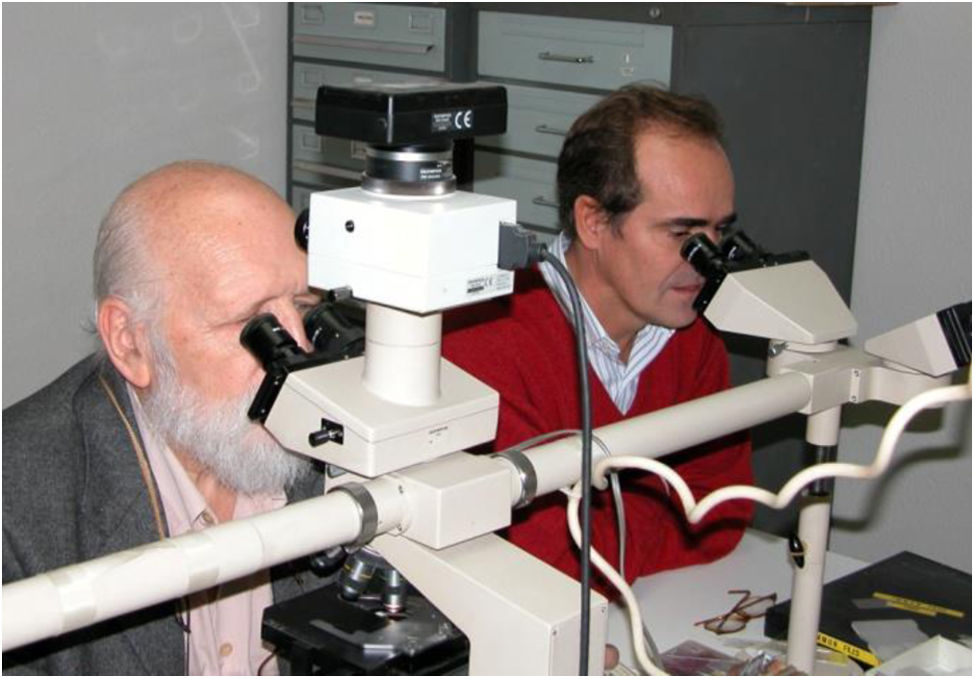
Studying cases with Prof. Sánchez Yus at the multiheaded microscope in the Dermatopathology Laboratory of Hospital Clínico San Carlos was the best part of every morning during our residency years. He always said that every biopsy, even the most routine and repetitive ones, such as basal cell carcinomas or conventional intradermal melanocytic nevi, contained some interesting histologic or histopathologic finding, and he would not move on to the next case until he had shown that particular feature to the residents.
It was not unusual to see him diagnosing chronic lymphocytic leukemia in the blood surrounding a small skin specimen from a basal cell carcinoma, and admiration for his brilliant diagnoses captivated any resident. For me, it was a striking contrast during my dermatopathology fellowship, when Prof. A. Bernard Ackerman at New York University (New York, United States) would establish a diagnosis in 2 milliseconds and immediately move on to the next case. I then realized that there were two very different ways of studying dermatopathologic cases. Fortunately, in the Dermatopathology Laboratory at Hospital Clínico San Carlos in Madrid, we did not have to diagnose 500 biopsies every morning.
After examining skin biopsies at multiheaded microscopes with many dermatopathologists from around the world, I have never met anyone who could make you enjoy a hematoxylin–eosin-stained section of the most ordinary and commonplace basal cell carcinoma as much as he could. He knew how to make biopsy interpretation enjoyable and engaging, to point out the findings you should learn from each specimen, and to correct your diagnostic errors while giving you criteria to avoid making the same mistake when faced with a similar case again. Only Prof. Sánchez Yus, and perhaps Prof. Ackerman, were able to transmit that passion for Dermatopathology to their students at a multiheaded microscope.
Over the years, I came to realize that Prof. Sánchez Yus and Prof. Ackerman had much in common, and one of the greatest pleasures Dermatopathology has given me was introducing Prof. Sánchez Yus to Prof. Ackerman and seeing them become friends for many years thereafter. Sadly, these two major figures in world Dermatopathology have now become part of the history of our specialty, but their legacy remains alive in the many dermatopathologists they trained.
I believe all of Prof. Sánchez Yus's students learned to enjoy every skin biopsy, whether routine or referred for consultation. All of us who trained with him have seen that, despite advances in other fields, skin biopsy remains the diagnostic technique with the highest yield in our daily practice. I only wish that those of us who trained under Prof. Sánchez Yus had been able to transmit that same passion for Dermatopathology to our own residents, but unfortunately, I do not believe we have.
It is difficult to single out Prof. Sánchez Yus's main contributions to the field of Dermatopathology because there were so many. In my opinion, his descriptions of new findings in rare and previously undescribed entities, although important, were not his greatest contribution. I believe his greatest merit was identifying new histopathologic findings and highly useful diagnostic criteria for common dermatologic conditions, such as panniculitis, vasculitis, keratoacanthoma, and melanocytic nevi, to mention only some of the areas in which he made important contributions that are now included in textbooks.
Whenever he was uncertain about something, he studied it prospectively in a large number of cases, and many times those studies were performed solely for his own knowledge and were never published. I remember, for example, that for two consecutive years he requested an orcein stain for every skin biopsy, regardless of the diagnosis, because he wanted to study in depth the elastic fibers in all dermatologic conditions and the characteristics of elastic fibers in normal skin at different anatomic sites. He meticulously examined the elastic fibers in more than 10,000 consecutive skin biopsies. Although he never published those findings, I always consulted him whenever I encountered any abnormality of the elastic fibers in my cases, and he always resolved my doubts. Our respective hospitals are directly opposite one another, and for many years I had the privilege of needing only to cross the street to resolve my diagnostic uncertainties. I have missed him greatly in recent years, when he was no longer there across the street.
Another professional characteristic of Prof. Sánchez Yus was his generosity. He always offered his diagnostic opinion altruistically on any case about which he was consulted, whether at a meeting or in a biopsy sent for consultation, regardless of where it came from. I believe that Spain's public healthcare system and public university system owe a debt to Prof. Sánchez Yus. He devoted his entire professional career to both institutions, always working in public medicine and never engaging in private practice. Yet, in my opinion, neither institution treated him as he deserved.
At the point in his career when his knowledge, experience, and international scientific standing were at their peak, Prof. Sánchez Yus failed to obtain the position of Head of Department for which he had applied; instead, it was awarded to others whose professional level was light-years below his. For political reasons, he also did not obtain the highest degree as Professor of Dermatology until only a few years before his retirement. As also happened to Prof. Luis Iglesias, despite being the best candidate and giving the best examination, the selection committee awarded the position to a different candidate. I was by his side during many of those unsuccessful examinations, and one of the things I admired most about Prof. Sánchez Yus was that these injustices never discouraged him; he continued working with the same enthusiasm.
I wish Spanish Dermatology and Dermatopathology had more dermatologists like Prof. Sánchez Yus. In my final year of professional activity, I am rather pessimistic and believe that contemporary Dermatology is following paths different from those I learned from Prof. Sánchez Yus and tried to put into practice throughout my professional career. I am not saying that the past was necessarily better, but it was certainly different. I hope, for the sake of the future of Dermatology I am wrong.
Thank you, Evaristo, for everything you taught us, both your residents and those who were not your residents but sat with you at the microscope. And thank you for a friendship that went on for more than 40 years. You always supported me more than I deserved. Dermatology and Dermatopathology will miss you. And above all, I will miss you, because I have lost my idol and my role model, both as a person and as a physician.
Rest in peace.